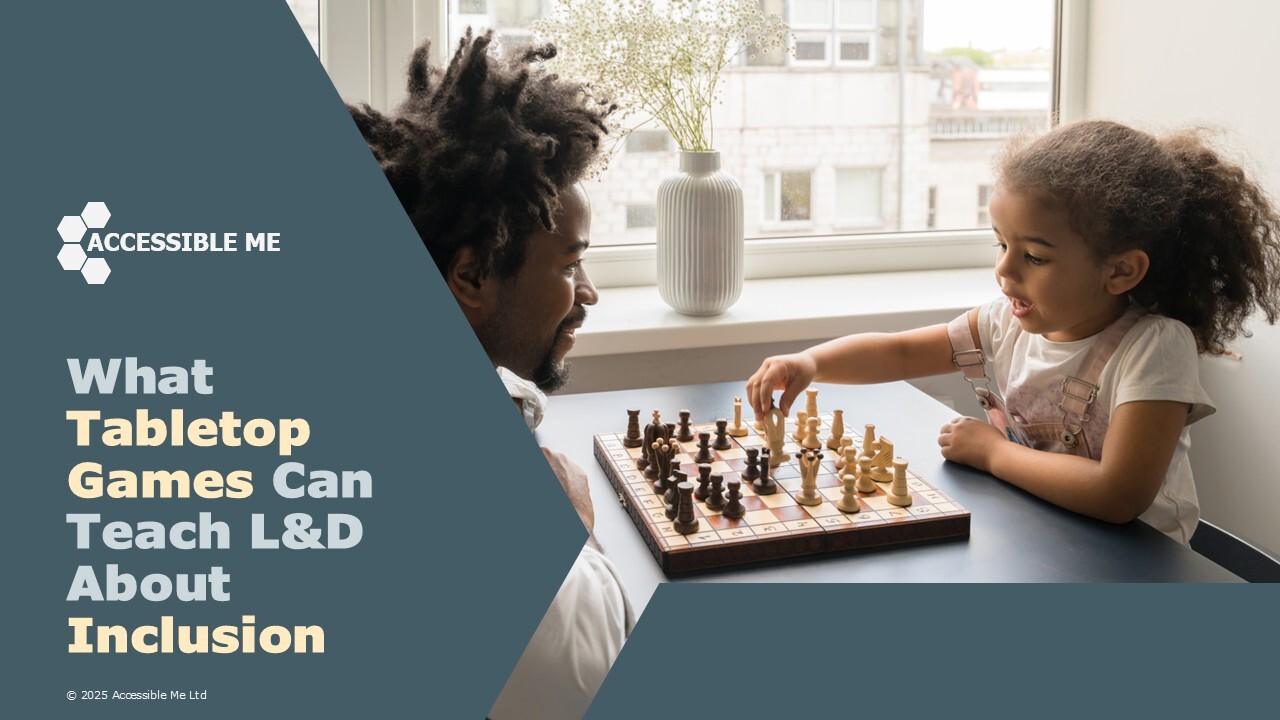
Tabletop games are often misunderstood.
Many people assume they are about competition, winning, or complex rules. In reality, some of the most influential modern tabletop games are quietly built on inclusion.
They show people how to collaborate under pressure.
They remove hierarchy without removing structure.
They make space for different strengths and ways of thinking.
They help groups succeed without leaving anyone behind.
In many ways, these games have already solved problems that learning and development teams still wrestle with today.
As we begin 2026, it is worth asking a simple question:
What can learning and development learn from the games people choose to play together?
Collaboration under uncertainty
Games such as Pandemic place players into a shared environment where conditions constantly change.
No one has full control.
No one has all the information.
Success depends on discussion, adaptation, and shared decision-making.
This closely mirrors inclusive learning environments.
Learners arrive with:
Inclusive design does not remove uncertainty.
It acknowledges it and supports people through it.
Good tabletop games show us that uncertainty does not have to create anxiety or confusion. With the right structure, uncertainty can create connection, problem-solving, and trust.
Distributed roles and asymmetric power
Many cooperative tabletop games give each player a distinct role.
One player may be better at healing.
Another may analyse patterns.
Another may manage resources or communication.
No role is more important than the others.
Each role exists to support the group.
This principle maps directly to inclusive learning design.
People do not need to learn in the same way to contribute meaningfully.
They do not need identical skills or identical experiences.
When learning experiences recognise different strengths, they reduce comparison and competition. They replace it with contribution.
Distributed roles support dignity.
Asymmetric power supports participation.
Shared goals with personal agency
Strong cooperative games balance two things at once.
A shared objective:
-
complete the mission
-
solve the problem
-
progress together
And personal agency:
Learning environments work best when they do the same.
Clear goals give learners direction.
Choice gives learners safety and ownership.
When people can control how they engage, they are more likely to stay engaged. This is especially important for neurodivergent learners and people managing cognitive load, anxiety, or previous educational harm.
Communication systems and constraints
Some tabletop games deliberately limit communication.
Hanabi is a well-known example. Players cannot see their own cards and must rely on carefully structured hints from others.
At first, this feels uncomfortable.
Over time, it builds deep listening, patience, and trust.
This is an important lesson for learning design.
Many learning experiences overwhelm people with information:
Games remind us that clarity matters more than quantity.
Thoughtful constraints can reduce cognitive load.
Clear communication supports accessibility.
Less noise helps people focus.
What learning designers often miss
Tabletop games succeed because they are grounded in human behaviour.
They balance:
Learning and development teams can apply these same principles.
Inclusive design principles inspired by tabletop games
-
Reduce unnecessary pressure
Design for exploration, not fear of failure.
-
Encourage collaboration
Let learners solve problems together.
-
Create meaningful roles
Help everyone contribute something unique.
-
Communicate with intention
Replace dense explanations with clear, simple guidance.
-
Build psychological safety
Allow people to try, adjust, and try again without judgement.
These approaches are not theoretical.
They work because they reflect how people actually learn.
A tabletop-inspired checklist for inclusive learning design
Use this checklist when designing or reviewing learning experiences:
-
Does every learner have a meaningful role?
-
Is the goal shared and clearly understood?
-
Are different strengths supported rather than flattened?
-
Is pressure reduced rather than amplified?
-
Is communication clear, focused, and manageable?
-
Can people collaborate without being ranked or compared?
-
Has cognitive load been reduced where possible?
-
Can learners retry without penalty or embarrassment?
-
Does the experience feel safe, fair, and human?
If you can answer yes to most of these questions, you are already designing more inclusively.
Why this matters for accessibility
Inclusive learning is not just about compliance.
It is about usability, dignity, and participation.
Many accessibility barriers are cognitive rather than technical. They affect how people process information, manage pressure, and feel safe enough to engage.
Tabletop games demonstrate that inclusive design does not have to be complex. It has to be intentional.
Closing thought
People often say learning should be more like play.
The deeper truth is this:
Learning becomes more inclusive when it follows the principles that the best games already use.
Shared goals.
Clear communication.
Psychological safety.
Meaningful roles.
Space to explore.
Respect for different ways of thinking.
As we move into 2026, inclusive learning does not require reinventing everything. Sometimes, it simply requires us to notice what already works.