Why experiential learning is essential for accessible and inclusive design
Many organisations try to build inclusion by giving people information.
A glossary.
A policy.
A checklist.
A slide explaining the difference between equality and equity.
Information matters.
But information alone rarely changes behaviour.
People do not become more inclusive because they know the right terms.
They become more inclusive because they have felt what exclusion is like and have experienced how small changes remove barriers for others.
Inclusion may begin as knowledge.
It only becomes real through experience.
Knowledge versus embodied experience in learning and development
Most learning and development programmes focus on cognitive learning.
We teach concepts.
We teach principles.
We test understanding.
We hope it transfers into practice.
But inclusion is not just cognitive.
It is relational.
It is emotional.
It is behavioural.
You cannot memorise your way into inclusive practice.
You have to experience what exclusion feels like and what inclusion makes possible.
This is the gap many organisations struggle with.
They know what accessibility is.
They do not always know how it feels.
Why experiential learning works for inclusion and accessibility
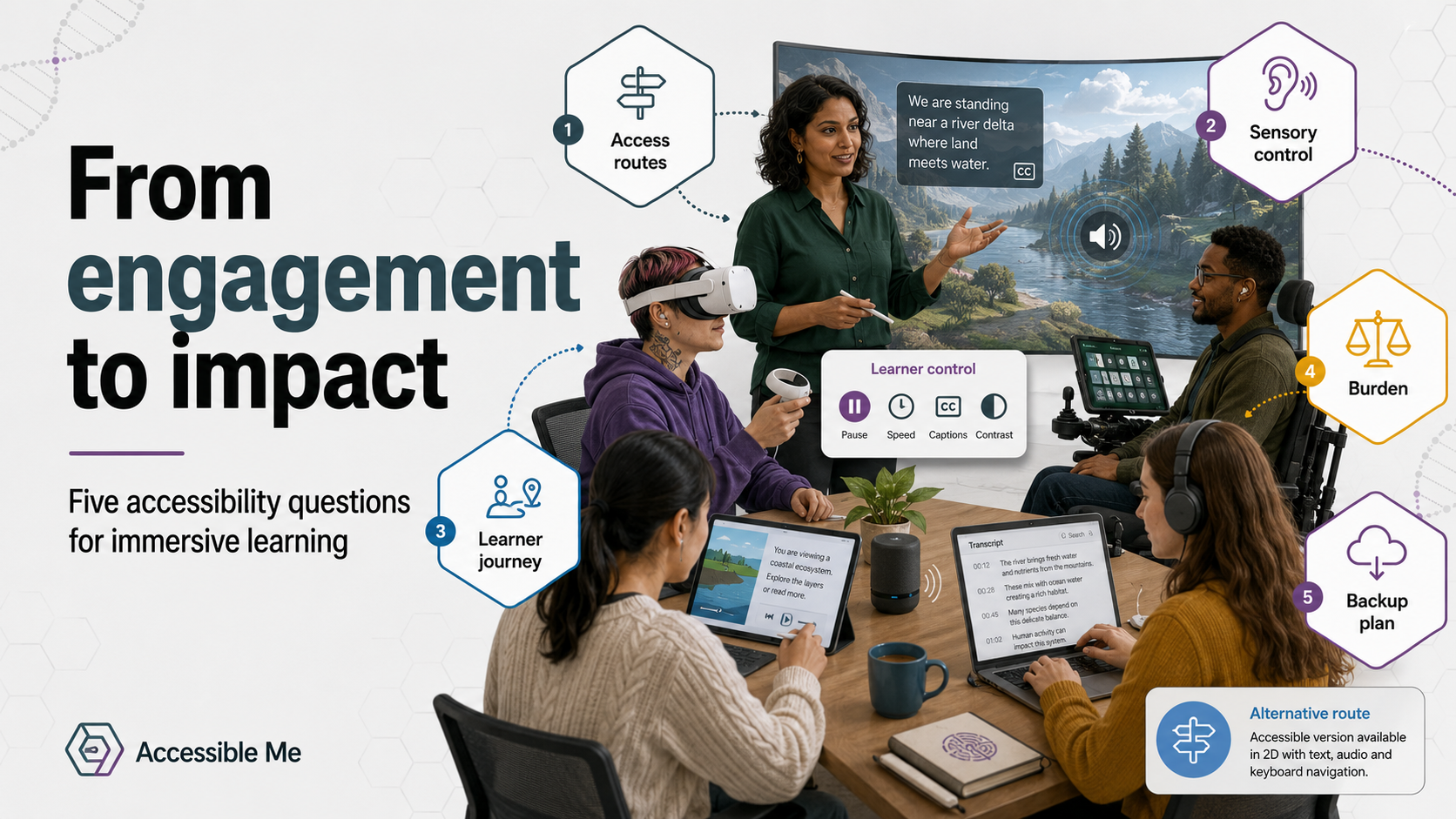
Experiential learning helps people move from awareness to action.
When someone struggles to read content with poor colour contrast, they do not forget the strain.
When they try to complete a task without captions, they immediately understand the barrier.
When they navigate a confusing interface under time pressure, they feel how stress amplifies exclusion.
These moments change perspective.
Not through guilt.
Not through shame.
Through direct experience.
This is why experiential inclusion work is so effective.
It builds empathy that is grounded and practical.
It connects accessibility to real human impact.
It shifts thinking from compliance to care.
This approach sits at the heart of A11yShip, the accessibility-themed escape room-style experience.
Participants explore real accessibility barriers together in a safe, cooperative environment.
Abstract principles become lived moments that stay with people long after the session ends.
Feedback from participants is consistent:
“This should be on the curriculum for every design student.”
“I finally understand accessibility as something that must be designed in, not added later.”
“I will never look at my work the same way again.”
What learning science tells us about doing versus knowing
Learning science supports this approach.
Active participation increases retention.
Emotional engagement strengthens understanding.
Immediate feedback supports long-term behaviour change.
When people only read about accessibility, details fade quickly.
When they experience barriers themselves, even briefly, understanding becomes instant and lasting.
This is the shift:
-
From knowing to doing
-
From theory to practice
-
From policy to behaviour
Inclusion sticks when it is experienced, not explained.
Inclusion as a practice, not a concept
Inclusion is not a one-off initiative.
It is a practice that lives in everyday decisions:
-
The font someone chooses
-
The structure of an activity
-
The way feedback is given
-
The pace of a session
-
The mechanics used to motivate learners
When organisations treat inclusion as a checklist, learning becomes passive.
When they treat inclusion as practice, learning becomes shared responsibility.
Experiential approaches bring inclusion into the room in real time.
People feel it.
People discuss it.
People practise it together.
Then they carry that understanding into their work.
How organisations can embed experiential inclusion into learning
Here are practical ways to make inclusion active inside your learning culture:
Start with low-pressure experiences:
For example, ask teams to review a piece of content for accessibility barriers or attempt a short task from a different access perspective.
Build experiential moments into existing training:
Let learners redesign a slide or interaction using accessibility principles, then compare approaches.
Use cooperative mechanics:
Shared success reduces pressure and increases participation, especially for neurodivergent learners.
Make reflection explicit:
Ask what felt difficult, what felt empowering, and what changed their perspective.
Use real organisational content:
Work with the barriers that already exist in your systems rather than abstract simulations.
Focus on practice over perfection:
Inclusive design is not about knowing everything.
It is about choosing to remove barriers wherever possible.
Doing is how inclusion becomes real
Inclusion becomes real when learning becomes lived.
Not because people memorise definitions.
But because they practise empathy.
They practise inclusive design choices.
They practise noticing barriers and removing them.
Doing builds understanding.
Doing builds care.
Doing builds culture.
If organisations want lasting inclusion, they must move beyond telling people what inclusion is and start helping them experience what inclusion feels like.
This is how meaningful change begins.