Accessibility
Accessible Me
CEO

Most people only realise a workplace does not work for them after they are already in it.
After the contract is signed.
After the first few weeks.
After the uncertainty has started to build.
After they have already begun asking themselves:
“Is it me?”
“Am I being difficult?”
“Should I just try harder?”
But sometimes the problem is not you.
Sometimes the environment was giving you signals from the start.
You just may not have known how to read them.
This matters for everyone.
But it can be especially important for neurodivergent people, disabled people, and anyone who has spent time trying to adapt to environments that were not designed with them in mind.
A role can look right on paper.
The title can look right.
The organisation can say the right things.
The values page can sound impressive.
But the real question is:
Can you do your best work in that environment?
That is a different question.
And it is one worth asking before you accept the role.
Many organisations say the right things.
They talk about inclusion.
They mention diversity.
They may have a page on their website about belonging.
That can matter.
But it is only the start.
Because inclusion is not a statement.
It is behaviour.
It shows up in how people communicate.
How they respond to questions.
How they handle difference.
How clear they make things.
How they treat people before they have any power in the room.
That last part matters.
The application and interview process is often your first real look at the workplace culture.
You are not only being assessed.
You are assessing them too.
Some signals are easy to check.
For example, is the organisation a Disability Confident employer?
That can be a useful starting point.
Not a guarantee.
But a signal.
Then look at the website.
Who do you see?
Does the imagery reflect different ages, races, disabilities, body types, and ways of being?
Or does everyone look roughly the same?
Look at leadership too.
Is diversity only visible in junior roles or marketing images?
Or does it appear in decision-making spaces?
Representation does not prove inclusion.
But a lack of representation can still tell you something.
The application process says a lot.
Ask yourself:
Is the form clear?
Are the instructions easy to follow?
Do they explain what they need and why?
Or does it feel like a test before you even get to the interview?
Some application forms are long, unclear, and full of repeated questions.
Some ask for information in ways that create unnecessary stress.
Some use language that assumes you already understand how recruitment works.
That matters.
Because if a process is confusing before they know you, it is worth asking:
What might the workplace be like once I am inside it?
Communication is one of the biggest signals of workplace culture.
Notice whether they:
explain the process clearly
tell you what will happen next
give timelines
follow through
send information in a format you can use
respond respectfully
Small things matter here.
If an employer says, “We’ll let you know by Friday”, then disappears for three weeks without explanation, that tells you something.
If they explain delays clearly and respectfully, that tells you something too.
Communication during recruitment is not separate from culture.
It is part of it.
This is one of the clearest tests.
You can ask:
“Do you provide interview questions in advance?”
“What adjustments are available during the recruitment process?”
“How do you support candidates who process information differently?”
The answer matters.
But the way they answer matters even more.
Do they sound open?
Do they know what you mean?
Do they treat the question as normal?
Or do they make it feel awkward?
A good employer may not have every answer ready.
That is okay.
But they should be willing to listen, learn, and work with you.
If the response feels defensive, vague, or dismissive, pay attention.
Sharing interview questions in advance is not about giving someone an unfair advantage.
It is about reducing unnecessary processing barriers.
Some people think best when they have time.
Some people communicate more clearly when they are not trying to decode the question, manage nerves, read the room, and produce an answer all at once.
Giving questions in advance can help people show what they actually know.
Not just how quickly they can respond under pressure.
That is not lowering the bar.
It is removing noise from the process.
During the interview, you may ask questions about:
flexible working
communication preferences
reasonable adjustments
meeting culture
support during onboarding
how decisions are made
Notice what happens.
Do they welcome the question?
Do they answer with examples?
Do they seem curious?
Or do they give polished but empty answers?
An inclusive workplace does not need everyone to agree all the time.
In fact, one of the strongest signs of psychological safety is whether challenge is welcomed.
If people can ask questions without being treated as difficult, that is a good sign.
If challenge is shut down early, that may continue later.
Lots of employers say they offer flexibility.
The better question is:
What does flexibility look like in practice?
For example:
Can people work in different ways?
Can communication happen in writing as well as live meetings?
Are people trusted to manage energy and focus?
Are breaks normalised?
Do managers understand that flexibility is not the same as lack of commitment?
There is a big difference between:
“We have a flexible working policy.”
and
“Here is how people use flexibility here.”
Policies matter.
But behaviour tells you whether the policy is alive.
Some support sounds good until you look closely.
A wellbeing page.
A generic employee assistance programme.
A statement about bringing your whole self to work.
These things may help.
But they are not enough on their own.
Better questions are:
What happens when someone is struggling?
Who do they speak to?
How are managers trained?
How are adjustments reviewed?
How is workload handled?
How are people supported during change?
Support needs to be practical.
Otherwise, it becomes decoration.
Look at employee stories.
Look at LinkedIn posts from people who work there.
Look at review sites such as Glassdoor.
Look for patterns.
Do people talk about trust?
Do they mention support?
Do they describe clear leadership?
Do they talk about burnout?
Do they say the values match the reality?
No workplace is perfect.
Online reviews can also be messy.
But patterns matter.
If several people describe the same issue, take it seriously.
Onboarding is often overlooked.
But it can make or break whether someone feels they belong.
Ask:
“What does the first week look like?”
“How will priorities be explained?”
“Who will I go to with questions?”
“How will success be measured in the first few months?”
These questions are not difficult.
They are practical.
If the answer is unclear, that may be a warning sign.
A lack of onboarding often leads to one of the most stressful workplace experiences:
Not knowing what you were meant to know.
Every workplace has expectations.
Some are written down.
Many are not.
So ask:
“What does good look like in this role?”
“What makes someone successful here?”
“What are the common challenges people face in this role?”
“What support helps people do well?”
These questions help reveal whether success is clearly defined.
They also help you understand whether the role fits how you work.
Because if “good” is vague, people often fill the gap with guesswork.
And guesswork is exhausting.
No employer gets everything right.
That is not the test.
The better question is:
How do they respond when something needs to change?
Do they listen?
Do they explain?
Do they adapt?
Do they take responsibility?
Do they make support feel normal?
The right environment is not one where nothing ever goes wrong.
It is one where issues can be named, discussed, and improved without fear.
Before accepting a role, look for clear evidence that:
the recruitment process was clear
communication felt respectful
adjustments were treated as normal
they explained what “good” looks like
they gave practical examples of support
they welcomed questions
flexibility sounded real in practice
onboarding sounded structured
the culture felt safe enough to be honest
you felt able to be clear, not forced to perform confidence
None of these signs gives you the full answer alone.
But together, they start to build a picture.
This article is not only for candidates.
It is also for you.
People are assessing your organisation long before they accept a role.
They are reading your website.
They are noticing your forms.
They are watching how you communicate.
They are listening to how you answer questions about support.
They are deciding whether your inclusion work is real.
Not from your statements.
From your behaviour.
If you want to attract and keep talented people, especially people who think, communicate, or process differently, the experience cannot start after they join.
It starts before they apply.
Sometimes we take roles that are not perfect.
Sometimes we need the job.
Sometimes we do not have the luxury of waiting for the ideal environment.
That is real.
But even then, knowing what to look for helps.
It helps you prepare.
It helps you ask better questions.
It helps you spot where support may be needed early.
And it helps you remember that if something feels difficult later, it may not mean you were wrong to be there.
It may mean the environment needs work.
An inclusive employer is not one that has the best wording on its website.
It is one that makes things clear.
Listens without defensiveness.
Welcomes difference.
Designs support into the process.
And understands that people do their best work when they do not have to waste energy decoding the environment.
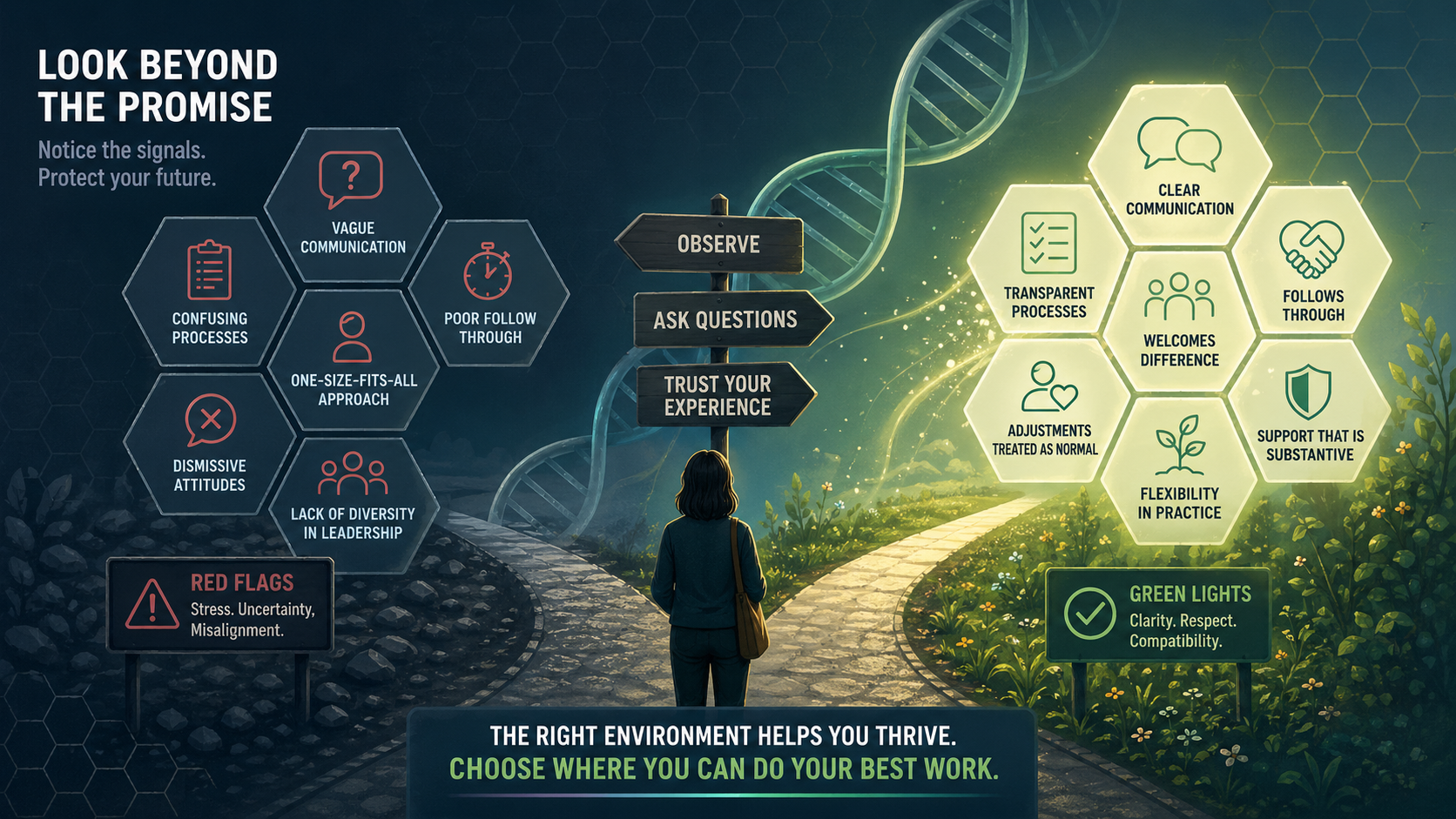
So before you accept the role, look beyond the promise.
Look at the behaviour.
That is where the truth usually sits.
At Accessible Me, we help organisations remove barriers from learning, communication, recruitment, and workplace systems.
That can include accessibility audits, training, workshops, strategy sessions, and practical support to help teams move from good intentions to real action.
If your organisation wants to make inclusion easier to understand, apply, and sustain, we can help.
Book an accessibility kickstart call to explore where your biggest barriers may be and what to do next.
Download our reflection guide and environment fit checklist.